
Certificate Confusion

There’s often confusion over two electrical certificates that are issued separately for different jobs, or together on the same job.
Here’s the how, why and when of the EICR and the EIC certificates:
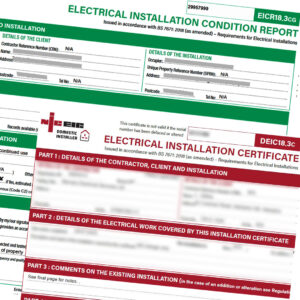
An Electrical Installation Certificate (EIC) is issued when:
✓ A property has been rewired with a new consumer unit
✓ A new consumer unit has been installed to replace an old one (maybe as a result of a failed EICR)
✓ One or more new circuits have been installed for a property extension (with or without a consumer unit upgrade)
✓ An existing circuit has been modified or a new one installed which could be a circuit for a garden cabin or an EV charger for example
In a Nutshell: an EIC issued when installation work has been carried out.
(i.e. a circuit has been added or modified (which require formal safety testing) and has to be notified (domestic only)).
An Electrical Installation Condition Report (EICR) is issued when it is required to be verified that an installation is ‘safe for continued use’. This usually occurs when:
✓ A rental or HMO property is due to be tested (every 5 years)
✓ A commercial or business property requires one for insurance purposes
✓ A home-buyer or home-seller is asked for one by their conveyancing solicitor
✓ A homeowner wishes to verify that their installation is safe for continued use.
In a Nutshell: an EICR is issued only when testing has been carried out (no installation work).
Both certificates have the same technical test procedure.
While the EIC is a record of technical (only) safety tests following an installation which may additionally be ‘notifiable’ for only domestic electrical work, the EICR additionally focusses on the overall condition of the installation and building regulation ‘Part P’ conformities.
Two very different reports with two very different legal requirements.
Real-Life Situations:
☞ A rental property has an existing EICR valid for 5 years. However half way through, the consumer unit is upgraded due to a new electric boiler installation (or whatever it may be) and an EIC is issued. However, at the EICR anniversary, a new EICR is still required irrespective of the fact that an EIC was issued half way through.
☞ A property has been prepped for rental. Normally, just the EICR would be issued. But where a minor circuit change has been made, or the board has been upgraded on recommendation, an EIC would be issued IN ADDITION to the EICR. The two documents are intended for completely different legal requirements.
☞ A rental property has 2 years left on an EICR, but there’s a change of tenancy. A valid EICR remains valid until its expiry date, even if there is a change of tenancy.
However, there may be a catch where unsafe alterations have made by a previous tenant such as poorly installed light fittings or DIY electrical work wouldn’t be identified by the existing EICR.
In this situation (which is quite common from experience), the onus is on Landlords to monitor and ensure the electrical installation remains safe throughout the tenancy period and that they, and their letting agents carry out visual electrical between tenancies, even when the EICR is still in date, to check for obvious damage, deterioration, or unauthorised alterations.
Certificate Branding Colours:
What do the different certificate colours mean? (In terms of the format issued by the NICEIC Scheme)
EICR:
The branded GREEN certificate is a general EICRs for domestic or commercial. Available to Domestic Installer or Approved scheme members.
However, Approved scheme members get access to RED coloured EICR certificates.
EIC:
The branded RED certificate is available to both Domestic Installer or Approved scheme members.
Have a Question?
Ask a related electrical question and receive a clear, factual response from an expert. Just £5.
Get an independent answer that reduces uncertainty, and helps you decide your next step with greater confidence.
Find out more and Submit your Question »