
Bathroom Electrical Safety Explained
 Bathrooms and Wetrooms are one of the most common places where serious electrical mistakes can be made.
These areas are often seen as an exercise in great design, which is fine, but legally and technically, they’re classed as ‘special locations’ in the electrical regulations which require particular design consideration in themselves.
Lighting, mirrors, underfloor heating, towel rails and extractor fans all sit in an area where water, bare skin and earthed metalwork come together. Small decisions made by builders, fitters or even well-meaning electricians can turn a compliant installation into a shock risk without anyone realising it!
This article explains what actually matters, what the regulations are trying to prevent, and how to recognise whether a bathroom installation is safe, before it becomes an EICR failure or, worse, an injury.
In this article you’ll understand:
- Why bathrooms are legally classed as a special electrical location
- How the bathroom zone system actually works
- Lighting
- IP ratings explained
- Class I and Class II – what they are and why they matter
- The real purpose of RCD protection in a bathroom
- Socket Outlets
1. Why bathrooms are legally classed as a special electrical location
A bathroom isn’t just another room with a sink in it.
From an electrical point of view it combines three things that dramatically increase shock risk —
water,
bare skin and
earthed metalwork — which lowers the body’s resistance and gives electricity an easy path.
Because of that, the Wiring Regulations treat bathrooms as a special location with additional restrictions on what electrical fittings can be installed and where they can be placed.
The problem is most installations look perfectly normal to a homeowner, yet small positioning or specification errors only become apparent during inspection, often after the room is finished and expensive to alter.
2. How the bathroom zone system actually works
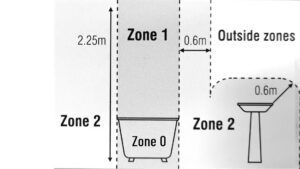 Bathrooms are divided into invisible areas called zones, based on how close electrical fittings are to water.
The intention is simple — the nearer something is to the bath or shower, the more restricted it must be so fittings must be suitable for the zones in which they reside (IP rated) , and designs must take into account which fittings are incuded in which zones.
Bathrooms include many different fittings from lighting to heating, and all must be suitable for use and suitably located. And that includes switches and isolators. While they may appear to be aesthetically pleasing, they may sit in the wrong zone, which is why even a ‘stunning’ bathroom or wetroom may fail an EICR.
3. Lighting
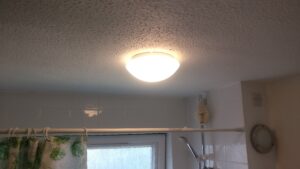 Lighting must comply with both IP rating and correct Zone location. Many ‘fancy’ or trendy fittings tend not to be IP rated and would fail an EICR inspection unless they were declared IP by the manufacturer.
Modern bathrooms tend to have IP rated downlights, or IP rated bulkhead fittings (shown).
However, some older bathrooms that have never been updated could have non-compliant, even potentially dangerous light fittings which would cerainly fail an EICR inspection and be noted as a ‘C2’.
Examples include:
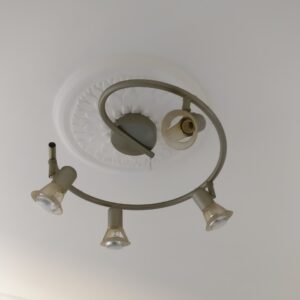
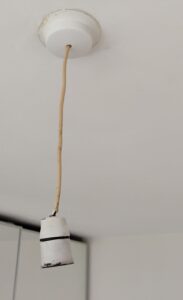 Both examples (yes I actaully have seen these in real-life bathrooms) are classed as ‘potentially dangerous’ and would need to be replaced before any property could be signed of as ‘safe for continued use’ under the EICR sign-off process.
4. IP ratings explained
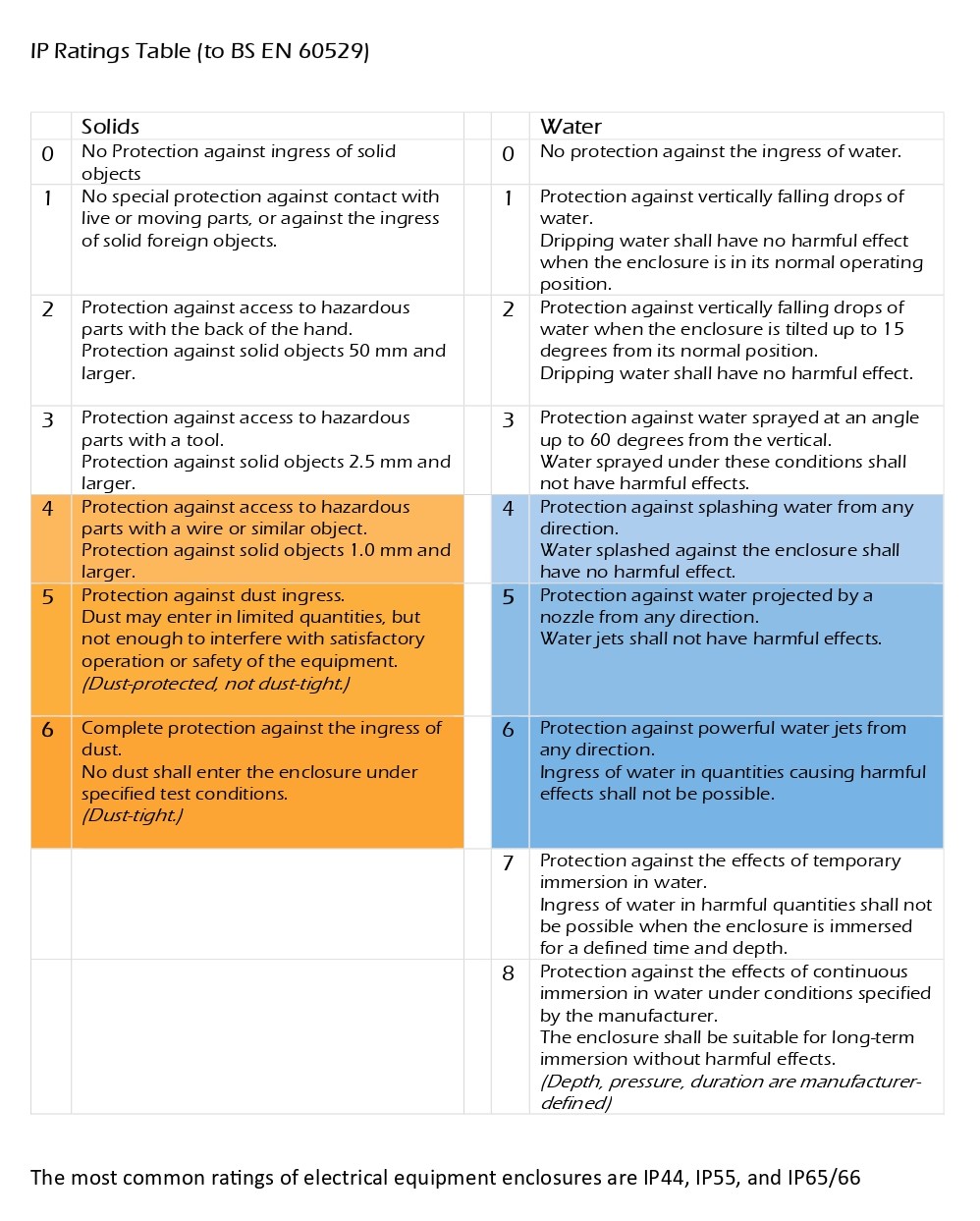 IP stands for ‘Ingress Protection’ and the two numbers that follow ‘IP’ indicate the levels of dust and physical ingress (the first number) and water (the second number) that the fitting or enclosure is designed to keep out.
The higher the numbers, the more resistance it has.
Click the image which gives a more detailed explaination.
Common ratings are ‘IP44’ for some bathroom fittings, but used more for external wall lights, while ‘IP65’ tends to used for light fittings used in Zone 1 bathroom locations and for garden use such as wall sockets or ground lighting.
IP ratings are generally printed onto product packaging so that you can easily identify its IP quality, then use official guidance on where in a bathroom or wetroom it can be used.
5. Class I and Class II – what they are and why they matter
Any electrical fitting marked with an earthing symbol must be earthed – this means that any touch voltage that may arise on exposed metallic parts is grounded to earth.
Any electrical fitting marked with a square symbol do not need to be earthed which means that all electrical parts inside are double insulated so there’s no possibility of receiving an electric shock even if (for whatever reason) the main electrical earth becomes faulty. Many fittings designed for use in bathrooms tend to be Class II or double insulated as this is the safer option over Class I.
However, class II fittings must still be installed in the correct Zone location as being ‘Class II’ does not equate to a specific IP rating.
6. The real purpose of RCD protection in a bathroom
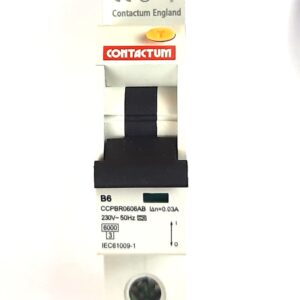 Whenever a bathroom is altered, the electrical circuits supplying it normally have to be RCD protected.
An RCD constantly compares the current flowing in the live and neutral conductors and disconnects the supply very quickly if some of that current escapes elsewhere — for example through water, pipework or a person.
Its job isn’t to protect the wiring; it’s to reduce the risk of serious electric shock in a location where the body’s resistance is low.
In older or existing bathrooms an RCD may not always be present and its absence alone doesn’t automatically make the installation unsafe, so it is usually recorded as a recommendation (C3) during inspection.
What is critical in those cases is the presence of supplementary bonding — the green and yellow conductors linking metal pipework, radiators and other exposed metal parts together. Without that, an electrical fault could place different metal items at different voltages creating an electric shock risk, which is why missing bonding is normally treated as a potentially dangerous condition (C2) during an EICR.
7. Sockets – in the UK (only)
Mains sockets are not permitted in bathrooms.
The only live electrical outlet permitted is a dedicated shaver socket (stand-alone or as part of a powered cabinet mirror) as they protect users from electric shock via an internal ‘isolating transformer’. Socket outlets do not offer this type of protection.
Any such socket discovered in a bathroom during an EICR would be an automatic fail (C2).
Independent Bathroom Electrical Review
If you’re planning a bathroom renovation, already mid-project, or have concerns about electrical work that’s been installed, you don’t have to rely on guesswork or conflicting advice from installers; I offer an independent bathroom electrical review.
You can send photos, plans, or an EICR comment and I will assess whether the installation appears compliant and whether any issues genuinely need addressing before you proceed or make final payment.
This is not an inspection and I’m not quoting for work. It’s a professional opinion to help you make an informed decision.
£49 Fixed fee
Written assessment
No installation upsell
Before tiles are fitted, ceilings closed, or remedial work approved — it’s often the point where independent advice is most valuable.
Request a Bathroom Electrical Review