
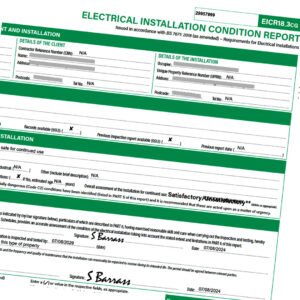
 An EICR (Electrical Installation Condition Report) or ‘EICR Certificate’ is a formal electrical inspection of a property’s fixed wiring, earthing, fuse box or consumer unit, electrical outlets and lighting.
The purpose of the process is to establish whether an installation is electrically ‘safe for continued use’.
Practically, this means that the assessor is looking to ensure the safety aspects meet the UK electrical regulations (BS7671) and Building Regulations (Part P – for domestic premises only).
What Happens During EICR Testing?
✅ The first part of the test is the visual survey which looks out for signs of obvious safety issues or non-conformities.
✅ The next part of the test is called the dead test where the power is isolated and the wiring between the fuse box or consumer unit is tested, the main earthing is tested, and RCD’s are tested.
Note: that WiFi is not available during this time – those working from home choose to hotspot to thier phone
Note: that there is no detriment to fridges and freezers during this short power outage!
✅ The final part of the test is the live test where electrical outlets (sockets and lighting outlets), metallic light switches and metallic fixed appliances such as cookers and ovens are adequately earthed.
EICR Codes Explained
If there are issues with the installation, codes are noted which are:
C3 – indicating recommendations or improvements, but are not safety related issues per-se
C2 – indicates issues that are ‘potentially dangerous’. These are many, but a few examples include missing earth bonding (water and gas pipes that should be connected to the electrical earth, but aren’t), live parts that could be touched in certain circumstances, or general safety-related non-conformities
C1 – indicates ‘immediate danger’ and this usually refers to things that could cause electrocution such as bare live electrical cables, earthing systems that are live but should be at zero potential, or protective devices that have been bypassed. Depending on the situation, a prohibition notice could be issued and the supply cut-off.
F/I – indicates ‘Further Investigation’. This means that some safetly related matter can’t be verified during the test and requires a later visit (at additional cost) to verify.
However, sometimes EICR codings can be misinterpreted and it could also lead to what appears to be excessive remedial quotes to put right.
You are fully entitled to question the codings, or use another electrician to re-quote. But it’s worth noting from my many clients that the original electrician won’t sign off the EICR if someone else has done the remedial work recommended which means that the electrician carrying out the work would have to re-test at additional cost.
Questions and Answers:
Q: How Long Does and EICR Test Take?
A: It can take between 1 to 1½ hour (for a bedsit/ 1 Bed Flat) to 3 or 4 hours for a larger house.
Time can depend on many factors including the number of circuits to be tested and whether decades of ‘bodge and muddle’ need to be worked through!
Q: Why does an EICR take so much longer (and cost more) than a Gas Safety test?
A: Simply, there’s a lot more to test and time costs money!
Q: Does an EICR cover repairs and non-conformities?
A: No. Any remedial work is a completely separate job. Note that while they usually do, the testing electrician has no obligation to undertake repair work – in which case an ‘unsatisfactory’ certificate must be issued.
Q: Does an EICR Include PAT Testing?
A: No, appliance testing is not covered, as the EICR focuses on the fixed wiring of the building or property.
Q: My dishwasher/ extractor fan/ smoke detector doesn’t work. Why weren’t they checked during the EICR?
A: An EICR is concerned with electrical safety only. Testing the function of appliances etc is not within scope since a faulty/ non-working appliance is not a safety risk and therefore there is no provision for such testing during an EICR.
Q: Why aren’t Smoke Detectors covered under the EICR?
A: While faulty, inadequate, out-of-date, or missing smoke detectors are a potentially serious matter, they come under ‘Part B’ of the building regulations, not ‘Part P’ which the EICR covers. It’s solely down to Landlords/ Estate Agents or Homeowners to ensure the adequate and up-to-date fire detection devices are installed in their properties.
Q: Is an EICR notifiable?
A: An EICR is not notifiable to local building control because an its an inspection and testing process rather than physical electrical installation, therefore there’s no legal requirement or provision to register it.
Failed EICR, What’s Next?
If your Electrical Installation Condition Report (EICR) failed (marked “unsatisfactory”), you must arrange for remedial work as soon as possible. Unresolved faults could pose serious safety risks and can invalidate your home or landlord insurance.
Landlords Note – Under the Private Rented Sector (England) Regulations 2020, the legal requirement is that any remedial work identified is remedied within 28 days (or sooner if the report requires it).
Your Electrician will note the issues they’ve identified and may offer a quote to remedy. Most electricians offer reasonable quotes to get these essential matters resolved as soon as.
But there may be times when a customer wasn’t satisfied about how the test was carried out and/ or the size of the remedials quote put forward.
If this is your situation, you are quite at liberty to arrange a second EICR by someone else.
If this person resolves genuine issues quickly and affordably, they can either run a new EICR for a pass/ satisfactory outcome, or they can couple together the original failed EICR, the quote, and the repair certificates together. Together, these documents serve as proof that your property is safe and compliant. If requested by local authorities or letting agents, this bundled paperwork is considered legally sufficient proof of compliance.
For Homeowners:
There’s less legal obligation for homeowners than for Landlords, but not one homeowner has ever refused any recommendation and repair I’ve put forward, and any responsible homeowner would do the same.
For home-buyers, the value-add is that any faults or issues are identifed during the buying process and remedied before completion – and before nice new flooring and decoration is done. Who wouldn’t!
But if you’re in a sticky situation and can’t find anyone who can give you a stright answer,
I offer a ‘virtual’ EICR second opinion.
When is an EICR required, and how long does an EICR last?
Depending on the type of premises, there are different recommendation (or requirements):
Domestic owner-occupied homes
- No legal requirement for routine EICRs
- Recommended every 10 years (or on change of occupancy) as best practice under BS 7671 guidance
Private rented properties (England)
- Legal requirement under the Electrical Safety Standards in the Private Rented Sector (England) Regulations 2020
- EICR required at least every 5 years
- Also required at the start of a new tenancy if the report is out of date
- Applies to all assured tenancies and most private lets
HMOs (Houses in Multiple Occupation)
- Legal minimum: every 5 years
- Applies under the same rental electrical safety regulations as other private rented properties
- In practice, many councils require:
- A valid, in-date EICR for licensing
- Updated reports at licence renewal
- Tighter control where occupancy risk is higher (bedsits, high turnover, shared facilities)
Commercial properties (shops, offices, schools, etc.)
- No fixed legal interval
- Inspection frequency is based on risk assessment (BS 7671 guidance)
- Typical intervals:
- 5 years – standard offices, shops, low-risk commercial use
- 3 years or less – higher-risk environments (public use, wet areas, heavy load use)
- 1–3 years – specialised or higher-risk sites (case dependent)