
Can Non Fire-Rated Downlights Fail an EICR?
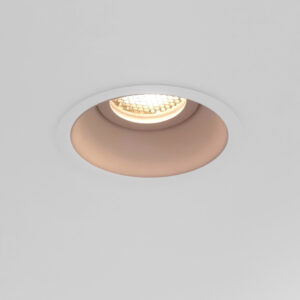
A modern LED downlight
Downlights have been popular since the late 1990’s and started their lives with Halogen bulbs long before good quality LED became the norm.
The bulbs were supported in a circular metal frame, some with open backs (non fire-rated) and others with a metal can (fire-rated) enclosure which contained a piece of material called an ‘intumescent strip’.
There were 12v (mainly intended for bathroom use), and 230v halogen for general use.
The idea is that you have a hole (or many holes) in the ceiling for your downlights. However, when you cut holes in a ceiling, you’re negating the fire integrity of the plasterboard (usually 12.5mm thick with a fire-rating of 30 minutes).
Which Rules Cover Downlights?
Downlight fire integrity requirements arise principally from Building Regulations Part B, while the electrical safety requirements are covered by BS 7671 (and, in domestic dwellings, Building Regulations Part P, which references BS 7671 as a means of compliance). Part B applies to both domestic and commercial buildings.
The EICR inspection includes fitting suitability (whether fire rated or non fire rated), quality of installation (is the ceiling hole too big for example), evidence of over-heating (such as burn marks around the fitting) and in bathrooms or wetrooms, whether they are IP Rated ».
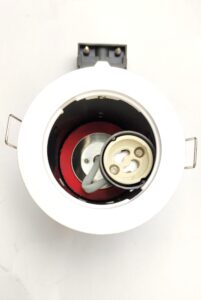 Fire-rated: In the event of a fire, the intumescent strip expands and fills the downlight can with a fire-blocking foam preventing flames entering the ceiling void essentially to retain the plasterboard’s 30 minute fire integrity.
The intumescent strip (in red) can be seen at the top/ back of this early 2000’s style halogen downlight can.
If you’re a homebuyer or a landlord and have these installed in your property with halogen bulbs, you might expect them to be categorised as a C3 on your EICR report with the recommendation that you at least upgrade the bulbs to LED.
(Halogen bubs were broadly banned from sale in the UK and Europe from September 2018 to improve energy efficiency, reduce electricity consumption and carbon emissions)
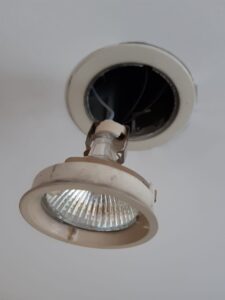
An old style non fire rated downlight
Non-fire-rated downlights came with an open back, i.e. no metal can like the fire-rated ones.
Sometimes, fire-resisting hoods could be installed behind each downlight, designed to contain flames from beneath, and to stop the heat of the halogen bulb (around 200c) from combusting any flammable materials around it, particularly in lofts.
But without hoods, the risks of fire spreading though a ceiling void via these non fire rated fittings may be obvious.
If you’re a homebuyer or a landlord with a property full of non-fire rated fittings the question is, would an EICR inspector treat these as a C2 or C3?
Well the answer depends on specific situations. Lets look at those.
1. In a standard UK house (or a house converted into flats) with wooden joists between floors. If there are habitable rooms above (particularly bedrooms) then an EICR would record a C2 because a fire could escape through the non fire rated fitting and combust the rooms above.
However in the same situation there are non fire rated fittings on the top floor with a loft above, then strictly, that could be recorded as ‘C3’, BUT diligent sparks might still tend to record it as a C2. (This is a prime example of where human judgement comes into play!)
2. In a purpose build apartment block that’s made of concrete (i.e. floors made of reinforced concrete), then the EICR would record a C3 since there’s no risk of flames reaching accommodation above through the concrete slab.
But it’s also worth noting that in a managed block, their fire risk assessment should be expected to confirm specific requirements.
Issues with Halogen Downlights
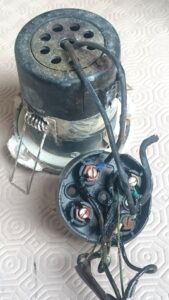 When we all ran ceilings full of halogen downlights consuming around 50 watts of power per bulb and running at around 200 celcius per bulb, heat build-up and fire risk were the big issues.
When installed into home conversions with rear extension roofs full of hard foam insulation, inevitably this caused a fire risk.
As you can see in the image, the heat toasted the wires and junction block, but didn’t start a fire due to fire retardant electrical materials, and RCD protection tripped the circuit.
However, had their been flammable materials around the can in such places as top floor ceilings with a loft above, this potentially caused a much greater combustion risk.
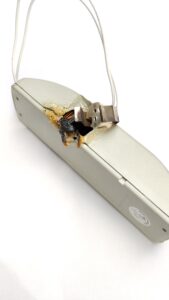
An old style downlight transformer
Here’s an example of a 12v downlight transformer located in insulation and touching the side of a halogen bulb.
Again, fire-retardant materials prevented combustion and saved a fire situation.
This may or may not be picked up during an EICR as it’s not usual that every individual downlight is examined for such damage.
Modern Day Downlights
As of 2026, the past decade has seen a huge increase in LED bulbs and fitting safety. Fittings have become more compact while maintaining fire rating properties via the intumescent strip, and are mostly all 230v mains; the old style 12v transformers are now largely obsolete.
(some bespoke, ultra-slim LED under-cupboard lights still require a 12 or 24v driver (that term replacing the old style halogen transformer) due to their dimension constraints).
There are broadly two types on the market;
1. Compact LED fittings which are fire rated and IP rated with integrated LED and are designed to directly replace old bathroom downlights with a 60-70mm ceiling cut out hole without having to upsize the ceiling hole.
2. Modern open back fittings where the intumescent strip sits around the bezel of the fitting – these type are designed so that the bulb can easily be changed (rather than having to replace the whole fitting as per 1. above). The IP rating is achieved by choosing the correct type of bezel (the front plate) as either IP rated (for bathroom use) or non IP rated for general use.
So for those with modern LED fittings, and of the correct IP rating for bathroom or wetroom use, you can expect no adverse comments or code classifications on your EICR report.