
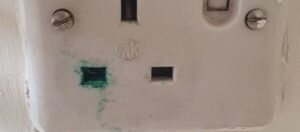
 As a homeowner, you may come across cables, switches or sockets that ooze a sticky green goo that has a strong odour.
Properties which have been renovated (including new wiring) would not be affected, but this green goo problem is prevalent in many older properties which may have been rewired back in the 1970’s or 80’s. Needless to say, it’s a sticky and unpleasant substance which gets all over your plugs, then your hands and the smell is quite difficult to wash off!
What Causes Green Goo?
The green goo that you see is the product of a reaction between decomposing plasticiser (a plasticiser is an oily liquid used in the manufacture of PVC compounds in the 1960’s and 1970’s ) and the copper conductors of lower quality PVC cables. It’s also known as cable ‘greening’ (not to be confused with copper verdegris (a green colour carbonate) which forms on copper conductors due to the presence of dampness).
The decomposition of the plasticiser is a very slow process and can either be caused when cables get too warm (by overloading and/ or loose connections which/electrical-consultant-uk/can-a-damp-wall-cause-electrical-problems/ cause a heat build up) or on even more inferior grades of plasticiser which were prone to greening even if the cables were not overheated.
The plasticiser itself is a clear oily liquid that is non-conductive. The green substance is a combination of copper oxide and plasticiser which is conductive. Therefore, whenever this green substance is found at socket outlets etc. it should be removed and the terminations cleaned (gloves should be worn) otherwise it is possible that tracking/overheating may occur. It is normally considered that if greening is found that rewiring should strongly be considered.
The good news is that the plasticiser chemicals of modern cables are designed to inhibit any decomposition of the plasticiser.
Risks
There are a few risks that are worth bearing in mind
1. Earth Faults: The reaction between the plasticizer and the copper can weaken the cable insulation, which over time may cause an earth fault (protected by an RCD), or a short circuit (protected by a fuse or circuit breaker) tripping out your circuit.
2. Conductor damage: Gooey contacts which cause increased resistance (and in turn heat build up) may cause switches and sockets to over heat causing local damage. However the risk of fire is very low as cables and outlets are made of non-flammable materials, and at the first sign of arcing within the outlet, the RCD (if you have one) should trigger and cut the power to the circuit preventing further damage.
3. Avoid getting the green goo on your hands (especially children’s hands as they may be tempted to lick it off causing sickness). Wash hands thoroughly with an anti-oil soap if possible such as:
> Degreasing or Dish Soap
> Activated Charcoal Soap
> Baking Soda Soap or Scrub
> Citrus-Based Soap
> Hand Soap with Tea Tree Oil
> Vinegar and Water Solution